
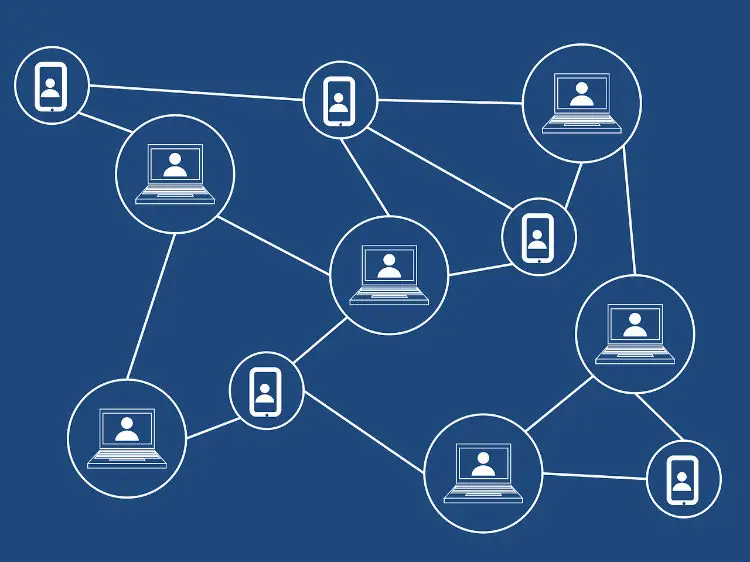
The word “blockchain” has been gracing headlines a lot lately. But what exactly it is often gets lost in the hype over what it might do.
At its most basic, blockchain is a technology or system for keeping records. It is sometimes called an “immutable digital ledger” or a “distributed ledger system.” Blockchains are effectively digital paper trails.
Blockchains are something like a database that lacks a central location and usually a central authority. They are effectively systems of recordkeeping where each participant has an updating copy of a piece of information. Changes to the information are recorded in “blocks” added to the record chain about their information. This information is publicly available for those within the system.
“They enable a community of users to record transactions in a ledger that is public to that community, such that no transaction can be changed once published,” explained several members of the U.S. Department of Commerce’s National Institute of Standards and Technology (NIST) in a recent dossier on the technology.
“Some existing blockchain technologies focus on storing wealth, while others are a platform for smart contracts (software which is deployed on the blockchain itself and executed by the computers running that blockchain). New blockchain technologies are being developed constantly to enable new use cases and to improve the efficiency of existing systems.”
Though blockchain and the cryptocurrency bitcoin are often used interchangeably, they are not the same thing. Keeping the concepts separate is helpful to thinking about both. Bitcoin was the first cryptocurrency created using blockchain technology, but it is not itself blockchain. Bitcoin is a product of the blockchain technology.
As reported in the Feb. 5 issue of WLJ, one of the world’s largest agricultural commodity traders sold 60,000 metric tons of U.S. soybeans (2.2 million bushels) to a Chinese processor using a digital blockchain platform. This was a point of attention at a recent Senate hearing on how blockchain and cryptocurrencies might be regulated (see more below).
By using a blockchain system, the seller Louis Dreyfus Co., the buyer Shandog Bohi Industry Co., and all the intervening mediators completed the transaction with all relevant documents—the sales contract, letter of credit, and inspection certificates—in digital format. Dreyfus said the blockchain approach resulted in “significant efficiency improvement for all participants in the chain. Time spent on processing documents and data has been reduced five-fold.”
Blockchain for cattle
Blockchain technology has many potential applications for agriculture. Some have lately been floating the idea of using it for things like animal identification and cattle sales.
At the beginning of February, the AgCenter outlined how a blockchain system might work in a smart contract form for the cattle industry:
“Blocks are little more than a single transaction at an agreed price point to transfer ownership of cattle for one head or a group of cattle. Each Block will be time sequenced and linked with encryption to other Blocks in the Blockchain. The Blockchain is comprised of the thousands of individual cattle transactions that occur each day, week, month and year that are linked together in time order to provide a transparent, non-repudiatable, trusted, and auditable ledger for the industry. Each transaction is confirmed online by the buyer and seller at the time of occurrence.
“A typical Block might contain the following fields of information:
- Date and time of transaction;
- Seller;
- Buyer;
- Number of head;
- Type;
- Quality;
- Sex;
- Base weight;
- Spot or forward market—[‘S’] or [‘F’] If forward list the month and basis to the most forward CME futures contract price or basis to futures month;
- Slide;
- GPS point of delivery;
- Delivery date range;
- Background—health and implants.”
AgCenter suggests blockchain as a natural territory for unique animal identification and transparency. It additionally proposes the creation of a National Beef Blockchain being placed in the hands of industry with an elected governance board working with the USDA’s Animal and Plant Health Inspection Service.
“Members from each industry sector would set the rules for data collection, for animal ID, and for Block creation, Blockchain linking and market price reporting. Additional data gathering can occur at each transaction stage including the final collection carcass data at slaughter.
“All data would be encrypted and no proprietary data would be released in public reporting. Only aggregate data reports would be provided to the industry members. The use of animal ID and Blockchain technology should drastically inhibit cattle theft and food fraud, further reducing costs to producers.”
AgCenter argued that applying blockchain technology to the cattle markets would allow the U.S. to “leap frog” international competitors and bring added value to the domestic supply chain.
Regulatory worries
The potential value of blockchain technology in agriculture was a perspective shared by both Sen. Pat Roberts (R-KS), chair of the Senate Agricultural Committee, and Christopher Giancarlo, chair of the Commodity Futures Trading Commission, during the recent committee hearing.
“Blockchain, or distributed ledger technology, can offer the economy significant benefits as it is used to create more secure, transparent ways for recordkeeping,” said Roberts in his opening remarks.
“My understanding is that potential benefits are substantial for multiple industries, from agriculture to financial services to healthcare and so on.”
Giancarlo agreed, calling the technology truly transformative. However, he characterized blockchain as a regulatory nightmare. The technology is, by its very structure, decentralized. Consensus and decision-making power is distributed between participants in a blockchain system rather than any sort of top-down or central hub of control. This makes the prospect of traditional regulation exceptionally difficult.
“The concept behind it is the decentralization of information and the bypassing of central authorities that for centuries societies used to verify information. If you think about it from a regulator’s point of view, we ourselves rely on verifiers, whether they be exchanges or whether they be data repositories. The traditional mode of regulation has been to license those verifiers to play a role in our regulatory framework.”
He stressed the need to “stay ahead” of the technological transformations that are already infiltrating agricultural markets.
“If we fall behind, we could find a real disruptive impact on our traditional mode of regulation.”
In his written testimony to the hearing, Giancarlo described blockchain technologies as among those “taking us into a new chapter of economic history.”
“They are impacting trading, markets, and the entire financial landscape with far ranging implications for capital formation and risk transfer,” he wrote. “Over time, these technologies may come to challenge traditional market infrastructure.” — Kerry Halladay, WLJ editor


