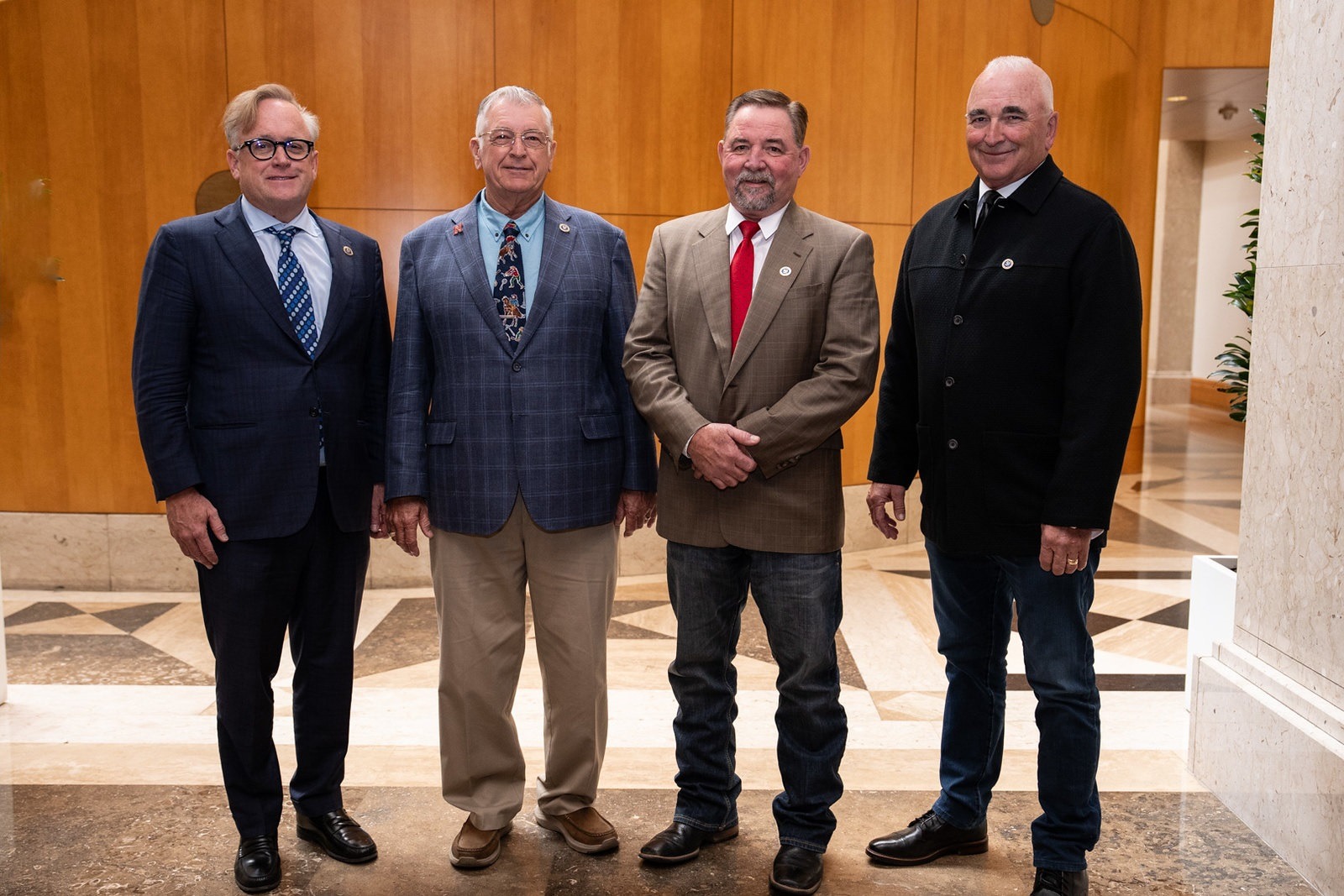
The U.S. Meat Export Federation (USMEF) wrapped up its Strategic Planning Conference in Palm Springs on Nov. 13 with the election of Dave Bruntz, a corn, soybean and cattle producer from Friend, NE, as the organization’s new chair.
“It’s an exciting time for the red meat industry and I am proud to serve as chairman of USMEF—looking forward to a great year,” said Bruntz, a past chair of the Nebraska Corn Board and Nebraska Cattlemen.
Bruntz thanked his wife, Ann, and his brother and nephew with whom he farms, for giving him the flexibility to serve in agricultural leadership positions.
As members celebrated USMEF’s 50th anniversary at the conference, Bruntz succeeded Jay Theiler of Idaho-based Agri Beef Co., who concluded his term as chair. USMEF’s chair-elect for the coming year is Darin Parker, director of Salt Lake City-based exporter/distributor PMI Foods. Ross Havens, a cattle producer who serves as marketing coordinator for Nichols Farms in Bridgewater, IA, is USMEF vice chair.
The newest USMEF officer is Gordon Spronk, DVM, a Minnesota veterinarian and partner in Spronk Brothers III, a multi-generational pork, corn and soybean-producing operation. Spronk, a past chair of the National Pork Board, will serve as USMEF secretary-treasurer.
Development of export markets
Friday’s closing session included a USMEF panel discussion on the evolution of meat exports to leading markets in the Asia Pacific and Latin America. The session focused on how some of the U.S. industry’s largest export markets developed over time, the lessons USMEF has learned, and how those lessons can be applied to emerging markets.
USMEF Director of Program Planning Ashley Gamon moderated the discussion, which included Vice President for Asia Pacific Jihae Yang, and Gerardo Rodriguez, regional director for Mexico, Central America and the Dominican Republic.
Yang and Rodriguez began by recapping conditions for the red meat trade when USMEF first began implementing market development efforts. Yang pointed out similarities between the Japanese and Korean markets, where U.S. beef initially found its place in premium foodservice, particularly upscale restaurants focusing on high-value cuts. Over time, market demand expanded into secondary cuts, and U.S. beef gained traction in mainstream retail chains.
While U.S. beef faced regulatory and market access barriers in Japan and Korea, it was warmly welcomed by restaurant operators as they saw highly profitable business opportunities. U.S. pork followed somewhat different paths in Japan and Korea, which had relatively high self-sufficiency rates for pork. This meant that while U.S. pork faced less government protectionism than beef, customer preferences initially leaned heavily toward domestic pork. But U.S. pork demand evolved over time for use in products that were tailored to the specific needs of processors, foodservice operators, retailers and consumers.
USMEF’s Mexico City office opened in 1991, allowing the U.S. industry to prepare for the new era of trade that would be made possible through the North American Free Trade Agreement (NAFTA). Prior to NAFTA, Rodriguez said Mexico imported very little red meat. The beef and pork available was domestic product sold in traditional markets. With little understanding of quality, consumers made purchases based solely on price or on the trusted advice of their butcher.
“Today, everything is different,” Rodriguez said. “Sometimes you don’t even see the butcher when you go to the store. Sometimes you don’t even go to the store because you buy online, right? So now we look for other attributes, especially consistency, convenience, quality and nutrition.”
Yang said development of key Asian markets goes through three major stages: market access, supply chain development and consumer demand development. While USMEF’s role has evolved along with these stages, one of the most important strategies through each stage is to build strong partnerships with key customers.
“These opportunities are not always obvious at the time, as they require passionate USMEF staff with the foresight to identify emerging market trends, along with customers who are willing to take the first step,” said Yang. “We don’t just follow market demand. In many cases, we work with our customers to create new demand.”
Yang also addressed the competitive challenges the red meat industry faces in many export markets.
“I want to emphasize that mature markets still require continued investment,” Yang explained. “Just because a market is well-developed does not mean that demand will sustain itself. Competition is increasingly intense across all product categories. For beef, for example, we face growing competition in the Asia Pacific region from Australian wagyu and Japanese wagyu. For pork, we are competing with chilled domestic product and chilled pork from Canada and Mexico, along with lower-priced, frozen commodity product from Europe and Brazil.”
Foreign Agricultural Service update
USMEF members also heard from Mark Slupek, deputy administrator for global programs at the USDA Foreign Agricultural Service. Slupek praised the financial support USMEF receives from a diverse range of agricultural sectors.
“USMEF brings together a broad coalition that’s deeply committed to expanding opportunities for U.S. agriculture around the world,” Slupek said. “These industry contributions are an important consideration in USDA’s funding decisions because they demonstrate a strong commitment to shared goals. Meaningful industry buy-in helps leverage federal resources and underscores a shared responsibility for achieving measurable results in export market development.”
Slupek also updated USMEF members on the status of fiscal year 2027 market development funds, noting that some implementation activities have been paused due to the Oct. 1 expiration of the current farm bill.
Industry panel discussion, USMEF awards
On Nov. 12, USMEF members heard from a panel of industry experts on the challenges facing U.S. producers, processors and exporters, while also focusing on opportunities for future growth. Moderated by CattleFax CEO Randy Blach, the panel included National Pork Board CEO David Newman, Iowa Corn Promotion Board CEO Craig Floss and Interra International founder and CEO Steve Isaf. Yang also joined the panel, offering observations from key Asian markets.
Floss highlighted the key role feedgrain and oilseed producers play in supporting red meat exports, which are seen as a catalyst for growth for their largest customer—the livestock feeding sector. Newman had high praise for international customers of U.S. pork, noting the innovative product offerings he’s observed when visiting foreign markets.
Long recognized as an industry trailblazer, Isaf was honored with USMEF’s Distinguished Service Award. At the same ceremony, Iowa Gov. Kim Reynolds (R) was honored with USMEF’s Michael J. Mansfield Award. — USMEF