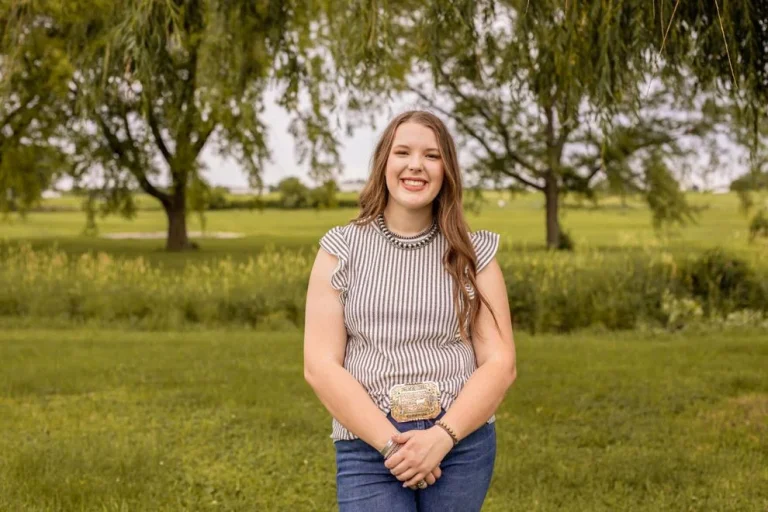
Raylee Honeycutt was recently appointed the executive vice president of the Montana Stockgrowers Association (MSGA), becoming the first woman to lead the organization in its 138-year history.
While Raylee may be the first woman to lead the organization, she has gratitude for the women who settled the American West and Montana on their own.
Raylee is originally from Fort Shaw, MT, where she raised 4-H livestock. She received her degree in agriculture education from Montana State University. After graduation, she moved to the Midwest and worked as the marketing coordinator for CountryMark, an energy cooperative in Indiana. While in Indiana, Raylee was the education and outreach leader for the Marion County Farm Bureau, home to Indianapolis, where she reinvigorated the membership to become—as she told WLJ—one of the leading urban agricultural Farm Bureaus in the nation.
Raylee said while in Indiana, she participated in the Indiana Agriculture Leadership Program, which allowed her to look at other perspectives, find a consensus when talking about difficult issues and find places to grow and mentor others.
Raylee moved back to Montana, worked for the Montana Office of Tourism in marketing and transitioned back to agriculture, initially working at MSGA as the director of natural resources.
Raylee said the decision to move to executive vice president was something that came naturally, as she has over 20 years of experience in grassroots membership organizations.
Raylee said she was fortunate to have people, regardless of gender, throughout her career to bounce ideas off of and have for mentorship and advice.
“I think what I bring is a unique balance of having served on the staff side from a membership organization, but also having sat in the seat of a member leader as well,” Raylee said.
She said wearing both hats allows her to bring a unique experience to the position at MSGA. Raylee continued that the group’s members “have been the fabric and the history of our organization for the last 138 years, and that will continue to be my top priority moving forward.” She said going forward, it will be about building the framework for the future of the organization from a membership, financial and policy standpoint.
“My goal is to look at what we’re doing through a lens that we haven’t done before,” Raylee said. “There’s a lot of ways that we can be smart in our collaborations and our coalitions that we’re part of and maybe sit at the table with groups or in places that we’ve never done before to engage and build our organization into the future so that we continue to have another 138 years of MSGA being the leader and the voice of the Montana cattle industry.”
Raylee recognizes that how we engage with information has changed in the last 50 years, and MSGA has to shift how it does business to capture people’s engagement. She continued there are many ways for younger members to engage, and it is vital to have strong leaders within the organization. The M Bar Academy is one such opportunity to bring value to MSGA members.
M Bar Academy, an 18-month MSGA leadership program that began in June 2022, was something MSGA members were only discussing. With Raylee’s background in adult learning and her previous experience with the Indiana Agriculture Leadership Program and a leadership program at CountryMark, she made the idea a reality. She said it has been fun to do.
Raylee says the first issue affecting ranchers starts with a national and global perspective on climate change and how the cattle industry incorporates sustainability. Second, the threat to the industry from plant-based and fake meats, along with “meat-free Mondays,” is a cause for concern for the organization. From a policy standpoint, Raylee said we live in a society of litigation, and producers’ decisions regarding grazing on public lands or other management decisions will draw the ire of someone, and they will sue to make policy changes.
Raylee said the environmental organizations have done a good job of fundraising so they can bring suits, and that is something MSGA and producers have to be prepared for, “even though it’s not something that we necessarily are comfortable with or like to do, but I don’t see it going away in the next five years.”
Raylee said the Bureau of Land Management’s decision on American Prairie grazing bison on federal lands will continue to be an issue. Raylee also sees water availability and drought at the forefront of the issues in the next 10-15 years—especially with the influx of people who moved to the state during the pandemic and the external pressure of people who do not align with agriculture. Raylee pointed out the growth of Bozeman in the Gallatin Valley and how water rights are becoming a topic of conversation between developers and the landowners.
“I think there’s an opportunity with landowners; continuing to tell the story about the benefits of cattle grazing and conservation and how they can work together is an opportunity that our industry can definitely have,” Raylee said.
Raylee said producers have been leaders in the conversation about wolves and grizzly bears with the general public. However, Raylee said the biggest threat comes from out-of-state folks that interject their preference on how apex predators should be managed in Montana, especially in and around Yellowstone National Park.
“We need to continue to advocate that there are consequences when living with apex predators, whether it’s human safety, whether it’s livestock safety, and that needs to have a higher priority than general population input,” Raylee said.
Raylee encourages people to join MSGA to fight for grassroots causes because cattle producers are stronger as an industry. She encourages women to be involved, regardless of if they think they are too young or not qualified to have a seat at the table. Raylee believes that once women have progressed through their careers, they must give back and mentor other women.
“If people aren’t sure if MSGA is a fit for them, I would love to learn how we can earn their membership and invite them to really consider joining our organization because all perspectives are very valuable when we work for the greater good of building a strong organization,” Raylee said. — Charles Wallace, WLJ editor