
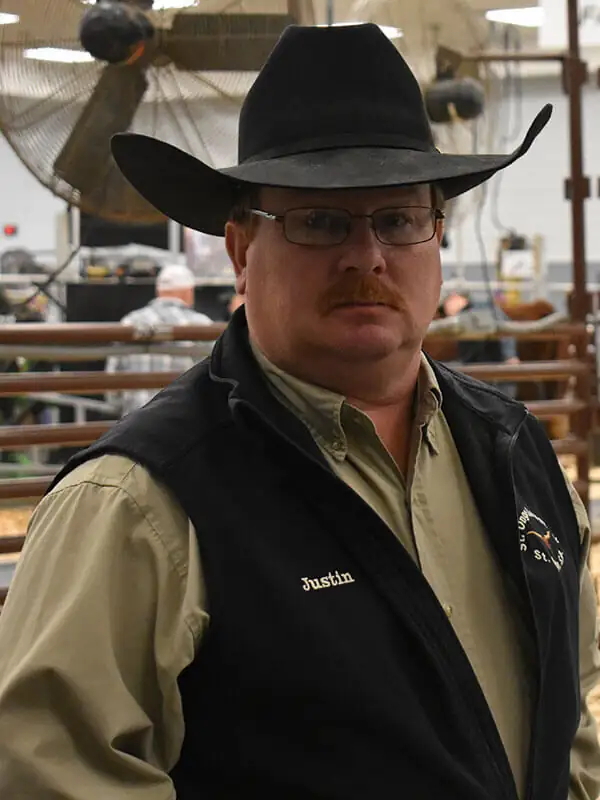
Justin Tupper, St. Onge Livestock general manager and vice president of the U.S. Cattlemen’s Association (USCA), is optimistic about the direction of not only the cattle market, but the overall cattle industry. Both his time at the sale barn and his role in the grassroots organization have given him a bird’s-eye view of the current happenings in the cattle business.
The cattle market has been extremely active over the summer. Justin explained the run was influenced by lighter numbers that are expected to continue into the fall. He noted that while cattle are bringing $100-150/cwt more than a year earlier, the extra margin is needed to offset rising input costs. Those rising costs, along with drought and herd liquidation, are the likely culprits for a more active marketplace as of late.
With ongoing drought in the Plains, liquidation has been in effect for several years now, Justin observed. Last year’s extreme drought exacerbated the speed of herd reduction, although he added that prices and other factors within the market were also contributors. Cow numbers are down about 20-30 percent compared to five years ago, which will have a huge effect on the marketplace, he said.
In addition, he is seeing producers who generally sell a load of heifers on video planning on holding onto them and breeding a few more heifers than usual. Justin doesn’t foresee a lot of bred cows—especially young bred cows—being available this fall and winter due to the reductions a year ago and producers needing to build up some numbers.
“We’re going to take some more cattle off the market in the short term, but I think there’s no question that our numbers are quite a bit down from even just four or five years ago,” Justin told WLJ.
For those producers waiting to see where the market heads into the fall before selling their cattle, Justin said it’s difficult to turn down the current prices. “One of the things that really looks like a challenge to me as we go forward is corn the last three or four days has been up exponentially, 40 to 60 cents,” he said.
“And as we look at facing $7 corn again, that’s pretty tough on these feed costs, and there’s a lot of outside influences—inflation, gas prices, war in Ukraine—that can have some influence. I definitely don’t like to be negative, but I think when you see these good prices, maybe take advantage,” he advised.
In addition to being on the forefront with the direction of the cattle market, Justin has had the opportunity to be a leader and voice for many in the industry with his involvement in USCA. Last summer, he had the chance to testify before the Senate Ag Committee and share his experiences in dealing with the current marketing system. Justin said his motivation to be a voice for the independent producer stems from the ownership structure at the auction barn, which recognizes the value in being a voice for the producers who bring their cattle to sell.
“I think from a very early age, I thought that somebody has to stand up for the producers,” he said. “It’s difficult for me to get my guys to believe the sun comes up in the east and goes down in the west, let alone agree on a cattle bill or agree on some of the really hard issues that affect our industry,” he said.
However, he says his role at the sale barn has given him the chance to work with numerous community members and connect more with the buyer side. Justin says this has inspired a big passion to work on reforms and make sure they’re working on issues that are going to bring value to the producer.
“I respect the people that don’t agree with every policy change we’ve tried to make,” he said. “We’ve worked really hard at USCA to try to involve as many of the groups and as many people as we can when we try to influence Congress or work on a bill that has balance and can work across all lines.”
Justin acknowledges this is easier said than done, but he believes the industry can be less divisive on the things people disagree on and more cohesive on the things they do agree on. He noted that he thinks the industry has made strong headway on coming together and working together on some of the core issues facing the cattle business, but there will never be a silver bullet or one bill that completely fixes the cattle market.
When it comes to solving issues in the current marketplace, Justin says, “It’s going to take a lot of work to build it back together. I encourage people to continue their membership in all organizations. If they want to be part of USCA, we’re excited to have them, but make sure you stay involved in the other organizations, too. There are times that they have a stronger voice on a different issue than maybe we can.” — Anna Miller, WLJ managing editor


