An outdated prohibition almost cost Heidi Nicholas her marriage. On paper, anyway.
When the chance arose to buy Empire Livestock—a business with six livestock auction markets across New York—she seized it. Nicholas understood the markets’ vital role in the region and saw no one else stepping up to keep them running.
But there was one major obstacle: her husband owned Nicholas Meat, a packing company in Pennsylvania. A Packers and Stockyards Act requirement, which predates modern livestock auctions, prohibits livestock market owners from owning packing companies.
Even though Nicholas planned to purchase the auction markets with personal, non-marital funds—and had the documents to prove that—she faced pushback from USDA’s Agricultural Marketing Services’ Packers and Stockyards Division.
At one point, she even told the authorities the couple would divorce if that’s what it took. That’s how strongly she felt.
Eventually, she was able to complete the sale.
But what about established auction market owners? Nicholas pointed out in many areas, there aren’t enough packers and processors to encourage competition or meet demand. Allowing markets to be part of the solution, such as opening a local locker or investing in a pooled funds regional packer, would support both markets and processors—while benefiting the producers who rely on these services.
A solution was recently reintroduced in the 119th Congress. The Amplifying Processing of Livestock in the United States, or the A-PLUS Act, and Expanding Local Meat Processing Act (House of Representatives 1648 and Senate Bill 782), would allow livestock market owners to invest in small and regional packers.
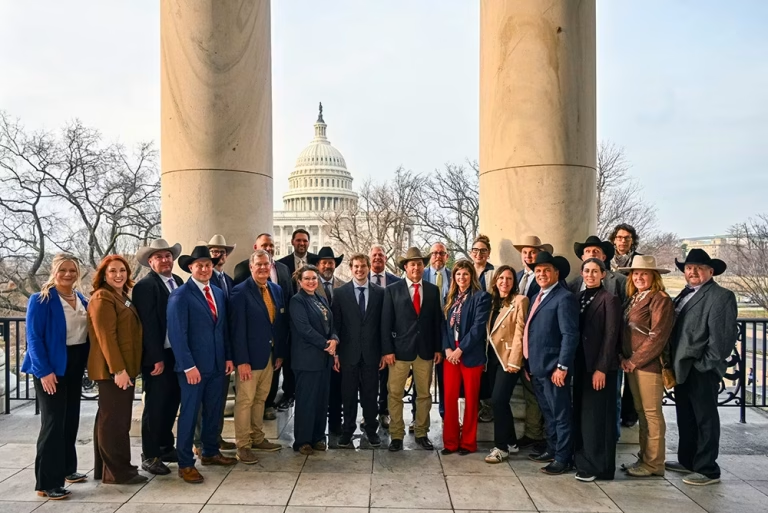
Supporting the bills was just one reason Livestock Marketing Association (LMA) members gathered in Washington, D.C., March 9-11. Throughout their annual fly-in, the group also advocated for key Tax Cuts and Jobs Act provisions to be extended before expiring. They also expressed thanks for Congress passing Livestock Dealer Statutory Trust in 2020, which improves recovery when livestock dealers default.
For first-time participant Teto Medina Wallace, who is manager and lead auctioneer for Santa Teresa Livestock Auction in New Mexico, it was an unforgettable experience—and one he cannot recommend enough to fellow LMA members.
“I came here with high expectations, but this has completely blown me away,” Medina Wallace said. “The quality of everything we’ve done and what I’ve learned … Just being in the halls of the heart and arteries of our nation has been something that has moved me tremendously.”
Nicholas agreed.
“I’m 66 years old and it’s the first time I’ve ever been to D.C.,” she said. “So, to be able to tour the Capitol and be in the agricultural committee room of the House of Representatives. It was so intriguing.”
Additionally, the two participants enjoyed the connections they made, both with policymakers and their fellow LMA members. Both were able to extend personal invitations to elected officials to visit their auction markets firsthand. They also had the rare opportunity to talk shop with other livestock marketers from 20 different states across the U.S.
Wallace Medina said he was impressed by the group’s ability to come together and work toward common goals, even though their operations may have differences.
LMA President Mike VanMaanen, who owns Eastern Missouri Commission Co., agreed.
“I’m just so proud of the number of members who took time away from their busy schedules and families to come advocate for our industry on Capitol Hill,” he said. “We’re so much stronger together. The relationships built and maintained on the trip will make sure our industry’s interests are considered in federal policy decisions.” — LMA