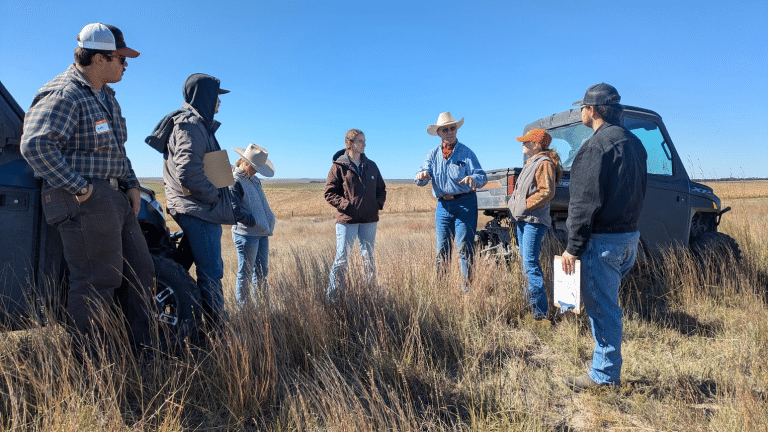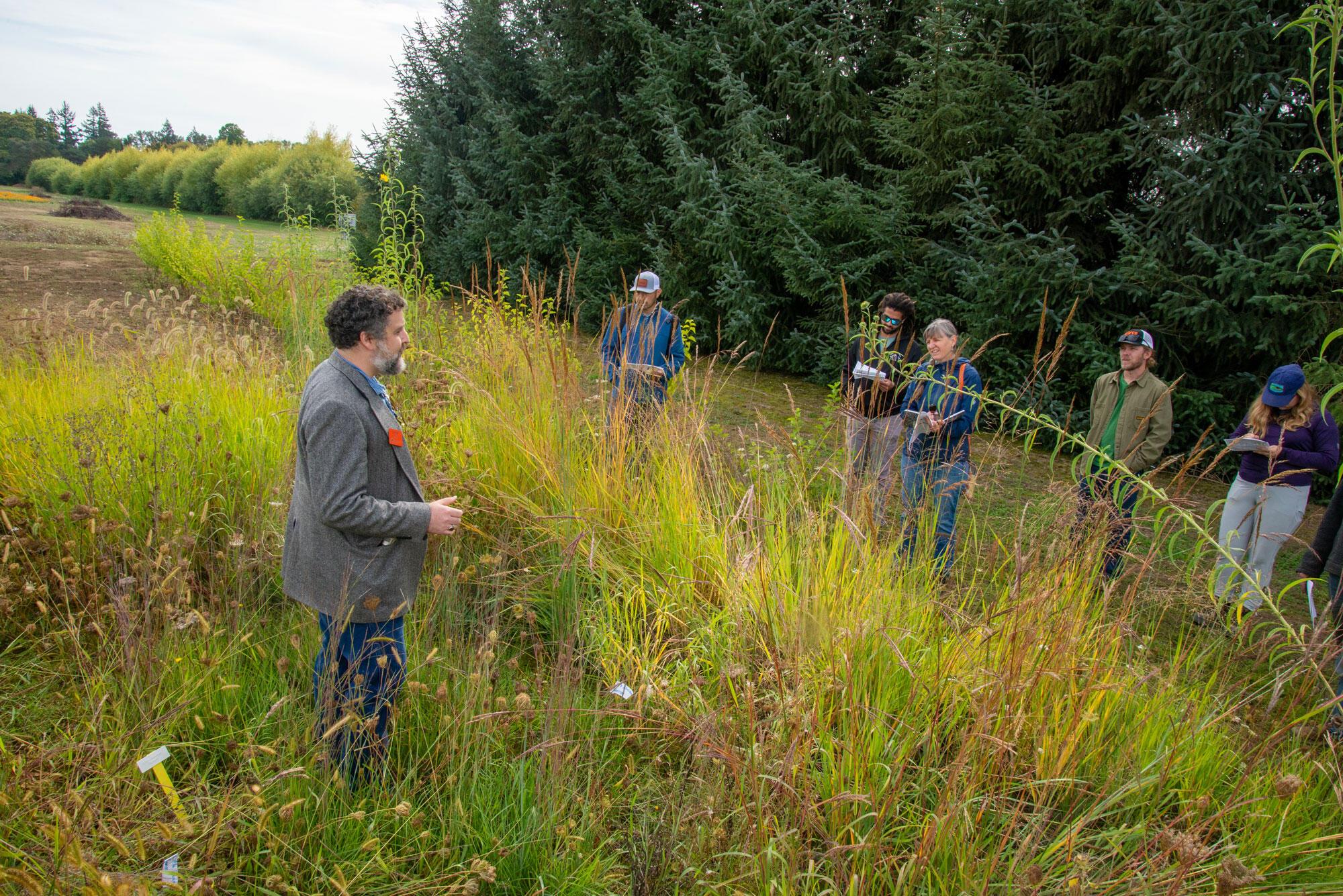
Shayan Ghajar wanted visitors to do more than look at the towering grasses surrounding them. He encouraged them to step into the plots, touch the plants and take in their beauty.
Some grasses stood taller than the people gathered among them. Others were shorter, with delicate seed heads that attendees examined up close. For Ghajar, the differences offered clues about how the plants might perform in Oregon pastures.
The Sept. 24 Perennial Warm Season Forages Field Day at the USDA Natural Resources Conservation Service’s Corvallis Plant Materials Center north of Corvallis, OR, offered a firsthand look at research that could help livestock producers address a familiar challenge: keeping animals fed during hot, dry summers when conventional pasture grasses slow their growth.
Ghajar, an assistant professor of practice and organic pasture and forage specialist with the Oregon State University (OSU) Extension Service, is testing perennial warm-season grasses that could provide another grazing option during the summer months.
Ghajar is a faculty member in OSU’s Organic Agriculture Program in the Center for Resilient Agriculture and Food Systems in the College of Agricultural Sciences. He focuses on organic, transitioning and low-input pasture management. His research explores ways to expand grazing options, improve forage production and help producers manage pastures with fewer inputs.
The field day built on earlier research into warm-season crops that Ghajar began in 2022. Those trials examined annual crops such as sorghum, pearl millet and cowpeas that could provide food, livestock feed or soil cover with limited irrigation. The perennial grasses represent another potential option, with the advantage of returning year after year once established.
Ghajar emphasized that the research is still in its early stages. The small plots offer promising observations, but more testing is needed before researchers can recommend the grasses for widespread use in Oregon.
The plots included switchgrass, big bluestem, little bluestem, eastern gamagrass and Sorghastrum nutans, along with a nearby wildlife strip that included Maximilian sunflower.
The grasses were seeded June 18, 2025, and irrigated beginning later that month at about 1.5 inches per week. The plots were not fertilized.
That late planting date mattered. Ghajar said he would prefer to seed in April or May and let the plants establish for a full growing season before grazing. Warm-season perennials generally should not be grazed in their first year because they need time to develop the deep root systems that help them withstand drought and produce forage later in the summer.
Even with uneven establishment, the trial offered clues about which species may hold promise.
Early results show promise
Switchgrass was the top producer in the trial. One plot produced an estimated 26,000 pounds of biomass per acre, Ghajar said, though he noted that figure came from an irrigated, unfertilized plot and should be viewed as an early indication rather than a final answer.
Big bluestem did not produce as much, but it stood out for consistency, with many plots yielding about 4,000-6,000 lbs. per acre.
Little bluestem also caught Ghajar’s attention. Shorter than the other grasses, it may have potential for vineyards and other settings where growers want a warm-season plant that uses water efficiently but does not grow too tall.
Eastern gamagrass remains a question mark. Ghajar said it established poorly, likely because of seed dormancy and germination challenges. But once established, he said, the species can be vigorous, persistent and tolerant of both flooding and drought.
Ghajar also walked attendees through the management differences between warm-season grasses and the cool-season species many Oregon producers know best. Most of the grasses should be grazed when they reach about 18-20 inches and left at about 10-12 inches, he said. Grazing them too short can damage their elevated growing points and reduce long-term persistence.
He also stressed that species choice matters for livestock safety. Switchgrass, he said, should be treated as a cattle forage because it can cause liver toxicity in horses, sheep and goats. Other species in the trial, including big bluestem, little bluestem, eastern gamagrass and Sorghastrum nutans, were described as suitable for a wider range of livestock when managed correctly.
More questions to answer
The field day also highlighted how much remains unknown.
Ghajar has not yet established whether the grasses can grow reliably without irrigation in Oregon, in part because previous unirrigated plots were planted too late in the season. Producers will also need practical strategies for managing weeds and making use of pastureland when warm-season grasses are dormant during winter and spring.
Still, he sees enough potential to keep going.
“There’s more questions than answers, but it’s still something that I think is a very important thing to consider for producers now,” Ghajar said.
Beth Thiel, resource conservationist with the Polk Soil and Water Conservation District, attended the field day to gather information for agricultural producers in her county. She was especially interested in learning how the grasses establish, what conditions they need and which livestock they can safely feed.
“I’m really excited to learn more about these warm-season ones because the Willamette Valley has warm summers,” Thiel said.
Ghajar hopes to leave the plots in place for future measurements and is interested in working with producers or technical service providers willing to plant the grasses next spring and share what they learn.
Beyond their potential to provide summer forage, Ghajar sees value in the grasses for conserving soil, improving water infiltration and providing habitat for birds and pollinators.
As the field day concluded, he encouraged attendees to walk among the plots, examine the grasses up close and appreciate their beauty.
“I think they’re the most beautiful grasses I’ve grown, and I’ve grown a lot of grasses,” he said. — OSU Extension