Packers continue to demand heavier finished cattle, while cow-calf producers are faced with the challenge of maintaining efficiency, longevity and profitability in their cow herds. How can producers balance these two seemingly contradictory demands?
With record-high prices across all classes of cattle, the beef industry is buzzing with both excitement and uncertainty. Cow-calf producers, in particular, find themselves at a crossroads. The industry is caught in a paradox—balancing the proven efficiency of moderate-framed cows with the market’s growing demand for larger, heavier cattle.
Research consistently shows that moderate-sized cows excel in efficiency. They wean a higher percentage of their body weight, bounce back quicker for rebreeding, and remain productive in the herd longer than their larger, heavier counterparts. Yet, market pressures are pulling in the opposite direction.
With the U.S. cow herd at its smallest since 1961 and retail beef demand surging, packers and feedlots are calling for heavier calves and larger carcasses to keep the supply chain humming. This contradiction—where efficiency supports one approach while demand pushes for another—leaves many in the industry searching for answers.
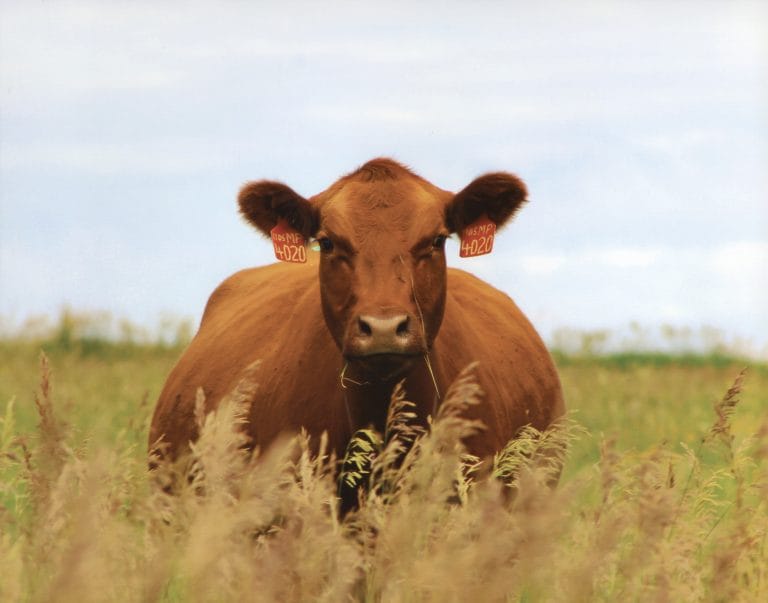
Moderate-framed cows
Every environment presents its own challenges, and what works in one region may not in another. A cow that thrives on the vast, semi-arid rangelands of New Mexico isn’t necessarily the best fit for the Upper Midwest—and vice versa. For the sake of this discussion, I’ll focus on what holds true in most production settings.
Let’s talk numbers. For years, research has reinforced a simple truth: moderate-framed cows—typically weighing between 1,100-1,300 pounds—are the most cost-efficient engines of the cow-calf business in most settings. A 2017 study from Ohio State University found that cows well-matched to their environment, especially those on the smaller to mid-sized end of the spectrum, excel at converting forage into pounds of weaned calf.
The key metric here is weaning efficiency—the proportion of a cow’s body weight she converts into a calf at weaning. Research consistently shows that moderate-framed cows wean an impressive 45-50% of their body weight, while larger cows (1,500 lbs. and up) often drop below 40%. That gap adds up fast, especially when feed costs are factored in.
In commercial operations, where efficiency drives profitability, bigger isn’t always better—despite market trends favoring larger cattle. While seedstock operations may supplement calves to maximize genetic potential, commercial producers generally rely solely on forage and milk. In these settings, moderate cows simply wean more efficiently, making them the more sustainable choice.
Fertility is another major advantage. Moderate-framed cows tend to maintain their body condition scores (BCS) more easily through tough seasons—whether it’s a harsh winter or a drought—because they require less forage to sustain themselves. Research from the University of Arkansas found that cows with a BCS of 5 to 6 at calving re-bred within 60 days at a 90% success rate, compared to just 70% for cows with a BCS of 4 or lower.
Simply put, smaller cows hit that optimal condition more reliably with fewer inputs, leading to higher fertility rates and tighter calving intervals—both key drivers of profitability.
Then there’s longevity, the ultimate cost-saver. Moderate-framed cows stay productive longer. A 2011 analysis by Kent Olson in BEEF Magazine found that smaller to mid-sized cows often remain in the herd for 10-12 years, while their larger counterparts start breaking down—whether from joint issues or metabolic strain—around 7-9 years old. That’s two or three additional calf crops per cow. Fewer replacements mean lower development costs and more time keeping proven, high-performing females in the herd.
In an industry where every dollar matters, the long-term benefits of moderate cows can’t be ignored.
Push for bigger cattle
ASA’s 2024 Fall Focus event in Amarillo, TX, explored the feedlot and packing sectors’ growing push for larger, heavier cattle. While carcass weights have steadily increased over the past few decades, the past couple of years have seen a notable surge driven by simple supply and demand dynamics.
In January 2025, the U.S. cow herd shrank to a historic low of just 27.9 million head, while beef demand has never been stronger. Retail sales hit a record high in 2024, climbing 8% over the previous year. With fewer cattle available and demand soaring, packers and feedlots have made their priorities clear: they need bigger cattle and heavier carcasses to keep the supply chain moving.
The data speaks for itself. CattleFax reported that hot carcass weights hit a record high in 2024, surpassing 900 lbs.—a full 36 lbs. above the 3-year average. Feedlots benefit from these heavier cattle, as greater growth potential translates to more pounds gained in the yard, diluting initial purchase price and improving margins. Packers win, too; more beef per hook means greater plant efficiency and a steadier supply to meet strong consumer demand.
This demand inevitably trickles down to the cow-calf sector. Producers are tempted to retain those big, growthy heifers from top-end bulls, knowing their calves will generate serious pay weight at weaning. But here’s where things get complicated. Those big bulls can often sire daughters that mature into 1,500-lb.-plus cows, significantly increasing the herd’s feed and forage demand. A pasture that once supported a moderate-framed herd is suddenly stretched thin, with cows consuming 20-25% more feed per head. And when the feed/hay bill arrives, efficiency—and often profitability—start to erode.
The hidden cost
Let’s break it down. A 1,200-lb. cow in good condition (BCS 5) typically requires about 24 lbs. of dry matter per day—roughly 2% of her body weight—depending on forage quality and weather conditions. Increase that to a 1,600-lb. cow, and daily intake jumps to 32 lbs.
Over a 120-day winter feeding season, that’s an extra 960 lbs. of hay per cow. Scale that up to a 100-head herd, and you’re looking at an additional 48 tons of hay—or a much steeper feed bill. And that’s assuming your summer pastures can keep up. Bigger cows graze harder, increasing the risk of overstocking, especially in dry years.
But the challenges don’t stop at feed costs. The bigger daughters of those high-growth bulls don’t just require more feed—they’re often less resilient. A 2019 study from Oklahoma State University found that larger-framed cows have lower rebreeding success in tough environments, leading to herd pregnancy rates as much as 10% lower than their moderate-framed counterparts.
So, while those heavier calves typically bring in more dollars at weaning, they often come at a cost: reduced weaning efficiency (weaning a lower percentage of a cow’s body weight), more open cows, and a shorter herd lifespan. In many instances for commercial cow-calf producers, it’s the classic case of winning the battle but losing the war.
Striking the right balance
So, what’s the path forward for seedstock producers? Again, every operation is unique, and there’s no one-size-fits-all approach. What thrives in North Dakota won’t necessarily succeed in Oklahoma—and vice versa. Fortunately, the data suggest that Simmental breeders are already moving in the right direction.
A study from the U.S. Meat Animal Research Center in Clay Center, NE, shows that Simmental-sired calves have a slight advantage in weaning weight over Angus-sired calves, yet their mature cow counterparts weigh in at 74 lbs. lighter than those sired by Angus bulls. This indicates that growth and efficiency don’t have to be mutually exclusive—Simmental genetics are proving they can deliver both.
The key is having an effective breeding strategy. For commercial cow-calf producers, crossbreeding is virtually non-negotiable. Heterosis doesn’t just boost weaning weights by 10%—it increases cow lifetime production by an impressive 23%. That’s a massive advantage for long-term profitability, giving ranchers more pounds of calf over a cow’s career without ballooning input costs.
In many cases, it may be worth considering a more structured approach to mating cattle. High-performance bulls with big growth EPD may produce sale barn standouts, but are they building sustainable herds? Their daughters will be the backbone of commercial operations for a decade or more; if they grow too big to thrive on available resources, profitability takes a hit.
Perhaps a plausible solution is greater differentiation, developing bulls specifically for maternal or terminal purposes. Research from the University of Nebraska shows that selecting sires with strong maternal traits—like stayability and moderate mature size—can extend cow longevity by one to two years compared to high-growth sires.
This study not only confirms the premise behind $API but also highlights the value of retaining females from maternal-focused sires. This approach builds a more efficient, longer-lasting cow herd, while still allowing producers to capitalize on high-growth genetics through complementary terminal sires.
The fix isn’t about abandoning performance, it’s about strategic selection. Mating moderate-framed females with top-tier maternal traits (Calving Ease, Stayability and $API), to terminal-focused sires ($TI), can generate feeder calves at the top of the market without compromising cow efficiency.
It’s not about choosing sides in the industry debate. It’s about bridging the gap.
Where do we go from here?
Here’s the challenge: science proves moderate cows win on cost and longevity, but the market demands bigger, heavier cattle. Cow-calf producers are stuck in the middle, trying to stay profitable without stretching their resources too thin. With numerous different environments, it goes without saying there’s no one-size-fits-all solution, but there are effective strategies.
Maybe it’s leveraging crossbreeding—Simmental’s strong suit—to merge efficiency with growth. Or maybe it’s working closely with your seedstock supplier to match the right bulls to the right job: maternal sires for herd longevity and terminal sires for top-dollar feeder calves.
As the industry wrestles with these competing pressures, producers need data-driven strategies to stay both profitable and relevant. This isn’t just theory—it’s an actionable, industry-shaping discussion. — Dr. Jon DeClerk, American Simmental Association executive vice president