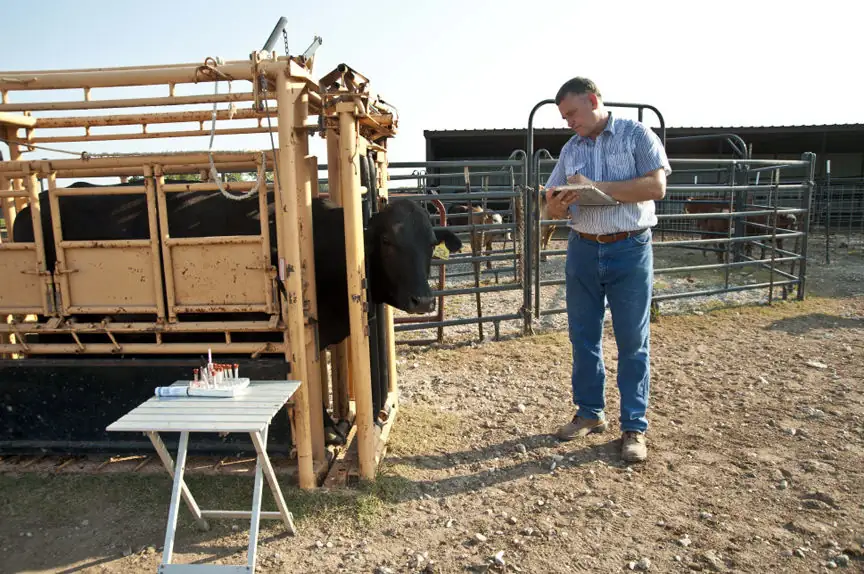
A management tool available to producers currently making selection decisions on yearling heifers is reproductive tract scoring (RTS). RTS is a subjective measurement that involves the rectal palpation of the heifer reproductive tract (uterine horns and ovarian structures). A subsequent assignment of a reproductive tract score is given, ranging from 1 to 5 (1 being immature and 5 having the presence of a corpus luteum), to assist the producer in making replacement heifer decisions.
Since age at puberty is difficult to measure directly, RTS can estimate pubertal status, and if performed before the onset of the breeding season, it can be a predictor of heifer reproductive performance, allowing for heifers with a poor breeding potential to be removed from the breeding group before any further costs are incurred. The RTS system has been shown to be a repeatable measure between and within practitioners and to be moderately heritable.
An RTS of 1 refers to a prepubertal heifer, an RTS of 2 or 3 refers to a peripubertal heifer (transitional stage) and an RTS of 4 or 5 refers to a pubertal (cycling) heifer. The reproductive performance of heifers with an RTS of 1 or 2 is less than that of heifers with an RTS of 3 or greater.
Heifers with an RTS of 1 or 2 are less likely to be cycling at the beginning of the breeding season and therefore are less likely to become pregnant, or if they do become pregnant, they do so later in the breeding season. This suggests that heifers with an RTS of 1 should possibly be eliminated from the breeding group. It is worth mentioning that some heifers do not exactly fit a particular RTS score, and it is up to the producer and/or practitioner to decide on which measures are to be given the most emphasis.
RTS should be done about one month or less prior to breeding if the score is to be used as a culling tool as an indicator of a heifer’s ability to conceive early during the first breeding season. If RTS is to be used as a selection tool to place pressure on age at puberty, the best time to evaluate the heifers is when approximately 50 percent of the heifers are thought to be cycling based on age, weight and occasional observations for estrus.
Another possible application of the RTS system is to assess the nutritional program being utilized by the producer. If RTS is taken within a sufficient time before the start of the breeding season (approximately 30 to 60 days), based on the results of the tract scores, the producer can adjust the ration to help the heifers reach developmental goals prior to the beginning of the breeding season, or the beginning of the breeding season can be adjusted.
If your heifers are a little behind schedule this spring, consult with your veterinarian about RTS. It can be informative and beneficial in the selection process of yearling replacement heifers. — Mark Z. Johnson, Oklahoma State University Extension beef cattle breeding specialist