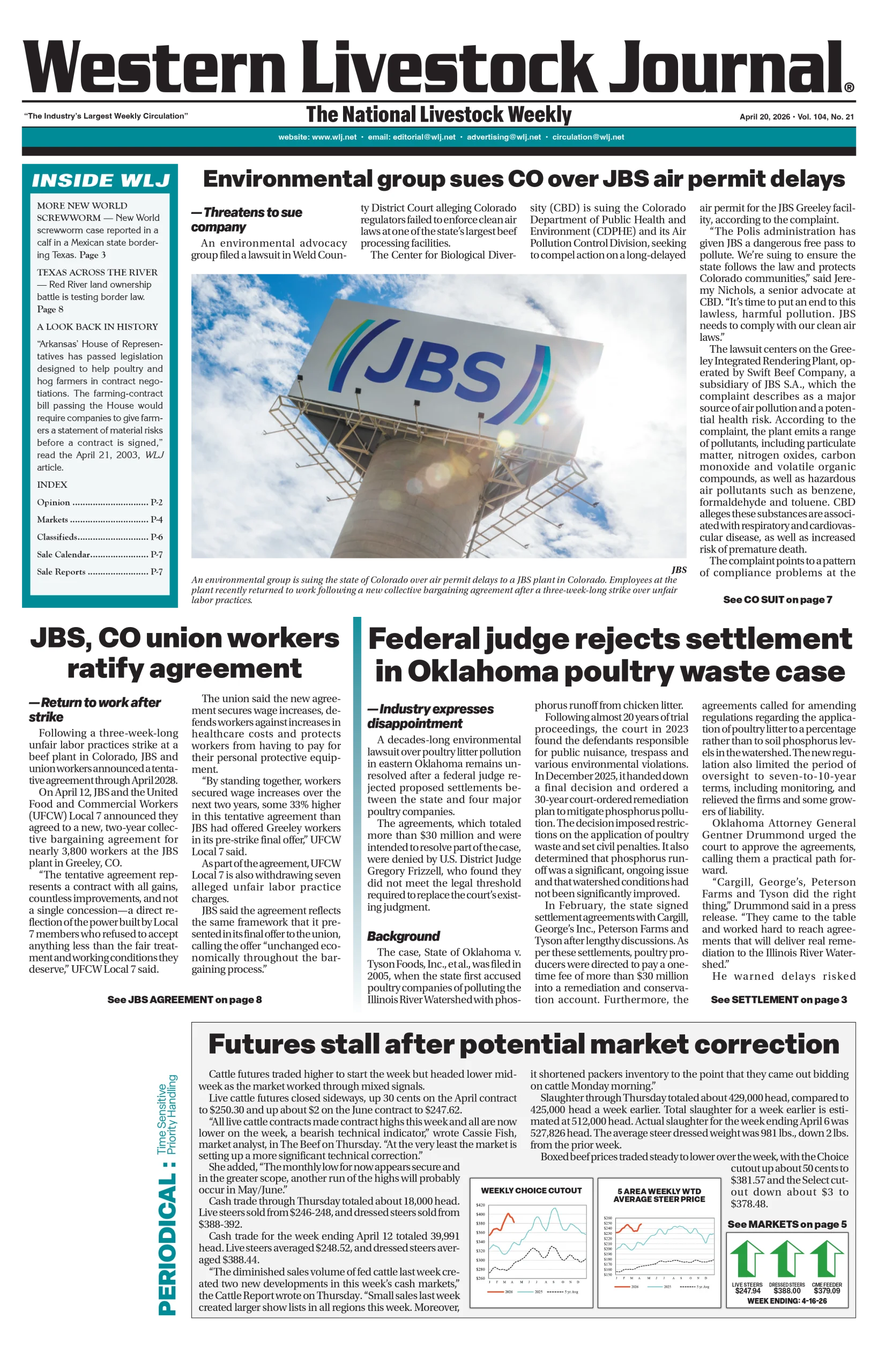
An environmental advocacy group filed a lawsuit in Weld County District Court alleging Colorado regulators failed to enforce clean air laws at one of the state’s largest beef processing facilities.
The Center for Biological Diversity (CBD) is suing the Colorado Department of Public Health and Environment (CDPHE) and its Air Pollution Control Division, seeking to compel action on a long-delayed air permit for the JBS Greeley facility, according to the complaint.
“The Polis administration has given JBS a dangerous free pass to pollute. We’re suing to ensure the state follows the law and protects Colorado communities,” said Jeremy Nichols, a senior advocate at CBD. “It’s time to put an end to this lawless, harmful pollution. JBS needs to comply with our clean air laws.”
The lawsuit centers on the Greeley Integrated Rendering Plant, operated by Swift Beef Company, a subsidiary of JBS S.A., which the complaint describes as a major source of air pollution and a potential health risk. According to the complaint, the plant emits a range of pollutants, including particulate matter, nitrogen oxides, carbon monoxide and volatile organic compounds, as well as hazardous air pollutants such as benzene, formaldehyde and toluene. CBD alleges these substances are associated with respiratory and cardiovascular disease, as well as increased risk of premature death.
The complaint points to a pattern of compliance problems at the facility, noting that state regulators have flagged multiple violations since at least 2019. Those include exceeding emission limits, operating outside permitted conditions and improperly maintaining equipment.
Under the Clean Air Act and Colorado’s Air Pollution Prevention and Control Act, major pollution sources are required to obtain a Title V operating permit. The Greeley plant fell under those requirements in January 2020 and was supposed to apply within a year, but the complaint states the application was not submitted until April 2022, well past the deadline.
“JBS applied for its state permit in April 2022, more than a year after it was required to do so,” CBD said in its press release. “By law, the division was required to grant or deny the application within 18 months. But four years after JBS’s application, Colorado regulators have failed to issue a permit or correct ongoing unpermitted pollution.”
The suit claims that because of the delay, the facility does not qualify for the “application shield” that allows some operations to continue while a permit is under review. The complaint argues that means the plant has been operating without a valid Title V permit since early 2021, putting it out of compliance with state and federal law.
JBS spokeswoman Nikki Richardson told the Denver Post that the company is committed to complying with all air quality regulations, though she acknowledged the permit application was submitted late but did not provide a reason.
“Since then, we have worked collaboratively and in good faith with CDPHE and believe we are meeting all current expectations,” Richardson said. “We remain committed to providing any additional information needed to support their review and determination.”
The lawsuit asks the court to declare the state in violation of the law and to order a final permitting decision within 90 days.
In addition to the state case, CBD issued a notice of intent to sue JBS directly under the Clean Air Act’s citizen suit provisions. That step begins a required 60-day notice period before a federal lawsuit can be filed. — Charles Wallace, WLJ contributing editor