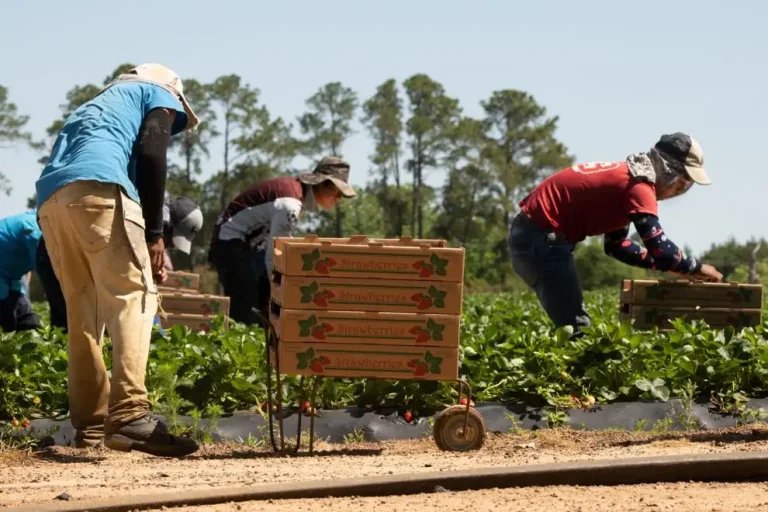
Proponents of California’s agricultural overtime law, Assembly Bill (AB) 1066, have called it a victory for farmworkers, while critics have asserted that it will harm the very people it was designed to protect.
New research by Alexandra Hill, University of California (UC) Cooperative Extension specialist and assistant professor in UC Berkeley’s Department of Agricultural and Resource Economics, shows that on average there has been a decrease in worker hours and wages.
Her estimates suggest that in the first two years of its implementation, California’s farmworkers worked a total of 15,000 to 45,000 fewer hours and earned a total of $6-9 million less on their weekly paychecks than they would have without this law in place.
In 2016, California passed AB 1066, legislation that removed existing overtime exemptions for farmworkers in the Fair Labor Standards Act (FLSA). The FLSA is the federal law that mandates many employment conditions, including overtime standards. In non-exempt industries, it requires that employers pay 1.5 times an employee’s regular pay rate for any hours worked beyond 40 hours per week.
Prior to AB 1066, agricultural workers in California were entitled to overtime pay for hours worked beyond 60 hours per week, but AB 1066 changed this beginning in 2019. The law mandated a gradual phase-in (over four years) of reduced overtime thresholds (lowering the weekly hours threshold by 5 hours/week each year) until agricultural employees are subject to the same overtime standards as workers in other industries (40 hours/week).
Many farmers feared that this new policy would drive food prices up, push them out of business or force a faster transition to mechanization. Most reported that they would reduce hours for individual workers to remain below the new overtime standards and avoid paying the higher rates.
However, media, advocacy groups and others heralded the law as a major win for farmworkers, as it would provide workers with more fair compensation for long workweeks. While long-term effects of the law for farmers and farmworkers remain to be seen, Hill’s work sheds light on the early effects of the law on worker hours and earnings.
Using worker-reported hours from the National Agricultural Workers Survey both before and in the two years after the law went into effect (2019 and 2020), economist Hill explored the effects of AB 1066. Overall, she finds that worker hours and earnings decreased as an effect of the legislation.
Her work highlights that the share of workers working 56-60 hours/week, just below the old overtime threshold, decreased by roughly half. Most of these workers shifted to working fewer hours; the share working 46-50 hours/week, just below the new (as of 2020) overtime threshold, increased by roughly one-third. She found similar reductions in worker earnings.
The share of the workforce with higher weekly earnings (between $600-800/week) decreased by roughly one-third, with most of these workers shifting into a lower earnings bracket of $400-500/week. These changes in hours and pay are consistent with employers behaving as they claimed they would—by cutting hours to avoid paying overtime rates.
Hill notes that these decreases in average wages and hours may be positive for those who want more leisure time and may—due to shorter workdays and weeks—improve workplace safety. However, she also warns that this can be detrimental for “workers and their families who were depending on this lost income to cover living expenses (and who) may now need to seek out second employment opportunities, negating these other benefits and adding the inconvenience of traveling between jobs.”
To learn more about the effects of AB 1066 on California farmworkers, read the full article tinyurl.com/26ybftb4. — UC Agriculture and Natural Resources