The California Department of Fish and Wildlife (CDFW) reports the state’s gray wolf population continues to grow, with new packs forming even as conflicts with livestock persist and policy debate builds over how best to manage those interactions.
According to the agency’s latest Quarterly Wolf News report, California now has 12 known wolf packs. Three newly recognized groups—the Interstate Pack in northern Modoc County, the Whitehorse Pack spanning western Modoc and eastern Siskiyou counties and the Long Valley Pack across eastern Sierra, eastern Plumas and southern Lassen counties—met the threshold of at least six months of consistent presence.
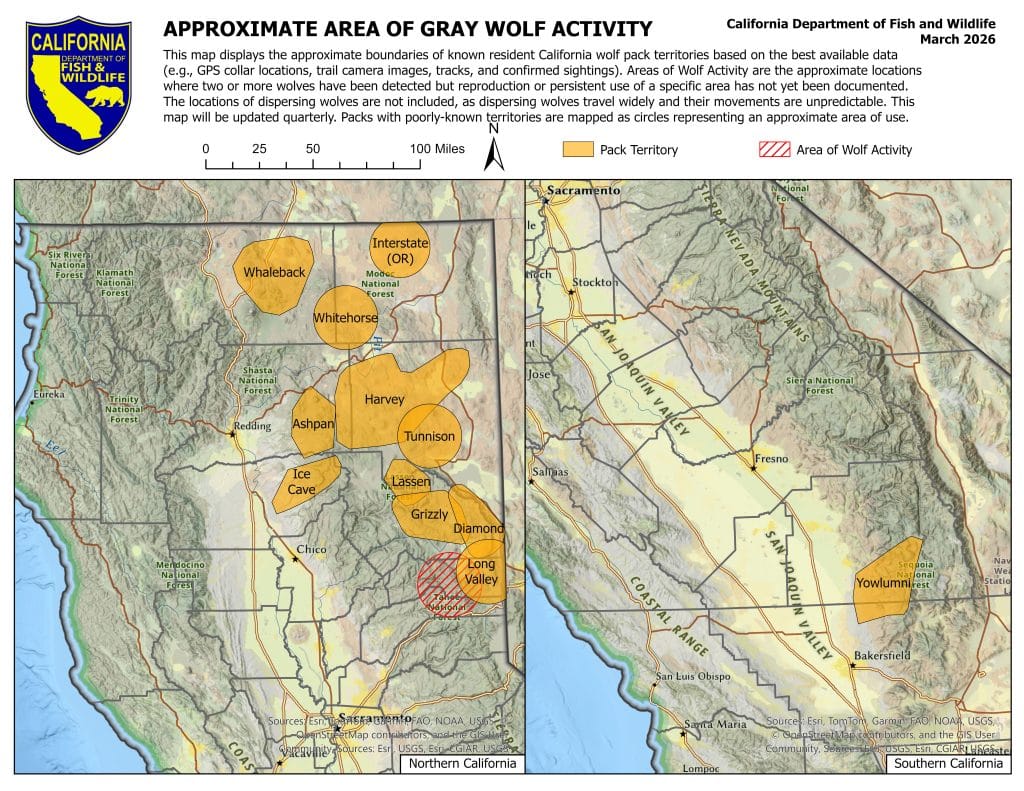
CDFW’s update shows packs remain active across much of northeastern California and into the Sierra Nevada, with monitoring conducted through camera traps, field surveys and genetic analysis. Packs such as Whaleback Pack in Siskiyou County and Harvey Pack in Lassen and Shasta counties continue to play a central role in wolf activity and interactions with livestock, according to the agency.
Depredations, compensation
CDFW’s updated Wolf-Livestock Depredation Report shows five additional confirmed depredations and five probable cases since late February. That brings the total to 26 confirmed or probable wolf depredations in the first quarter of 2026.
In total, the agency conducted 47 depredation investigations during that period, with more than half resulting in confirmed or probable wolf-caused losses. The report shows that Siskiyou County continues to see the highest concentration of losses, largely tied to the Whaleback Pack, which accounted for multiple confirmed and probable incidents during the quarter.
CDFW continues to administer its livestock loss compensation program. During the first quarter, the agency paid more than $179,000 across approved claims and is preparing to distribute additional funding from a $2 million legislative appropriation.
The department said coordination remains a priority, with ongoing engagement involving livestock producers, county agricultural departments, federal agencies and local organizations in areas with known wolf activity.
CDFW says it is working to expand its response options as wolf presence increases.
The agency recently reported progress toward issuing permits for more aggressive hazing, including coordination with county sheriffs to allow the use of less-than-lethal tools such as pepper balls. The goal is to deter wolves from targeting livestock and encourage a shift toward natural prey.
Additional efforts include improving access to collared wolf data for counties and exploring the creation of county-based liaison positions to strengthen communication with ranchers and local officials.
Coexistence legislation considered
At the same time, lawmakers are considering legislation to expand the state’s approach to wildlife conflict.
California Senate Bill 1135, the California Wildlife Coexistence Act, was recently passed out of the Senate Committee on Natural Resources and Water and is in the suspension file due to expected costs in the Appropriations Committee. The bill is opposed by the California Cattlemen’s Association and the California Farm Bureau.
The bill would establish a statewide policy that puts more emphasis on helping people and wildlife coexist, directing the department to reduce and manage conflicts through coordinated efforts with local partners while still supporting broader conservation goals.
Under the proposal, the coexistence program would take a hands-on role in responding to wildlife conflicts, tracking incidents and working to prevent them through nonlethal tools and best management practices. That includes investigating depredation events, maintaining a statewide reporting system and providing outreach, technical assistance and support to communities dealing with wildlife interactions.
The compensation program would provide funding for tools and practices that help deter wolf attacks, while also reimbursing producers for confirmed losses and certain indirect impacts, provided they are using approved nonlethal measures. The bill also directs CDFW to establish a Wildlife Coexistence Technical Advisory Committee to provide guidance, public input and program recommendations. It would authorize funding for partnerships supporting coexistence efforts and require the department to publish program information online by July 1, 2028.
CDFW estimates the program would cost about $28.2 million in its first year and $23.2 million annually thereafter from the General Fund, supporting 83 positions focused on incident response, technical assistance, research, enforcement and development of tools to reduce human-wildlife conflict. — Charles Wallace, WLJ contributing editor